

Some places in Croatia can be seen from the road, from a car, from a hotel terrace. Others only really exist once you approach them from the sea. The bays in this piece belong to the second kind. There is no road leading in, no car park, just water, rock, and a silence you only hear once you cut the engine and settle on anchor.
We picked four places from the Croatia 2026 route that best show why a catamaran gives you a different kind of access to the coast than any other way of travelling. This is not a checklist of attractions, but four different characters of bay: one quiet, one famous for its view, one hidden, and one close to a historic town.
Pakleni Islands and Palmižana
Just off Hvar lies a small archipelago known as the Pakleni Islands. This is where the water takes on that classic Adriatic colour, clear turquoise deepening into navy, and pine forest runs almost down to the shoreline. Palmižana, one of the islands in the archipelago, is known for botanical gardens planted by a family who began tending them over a hundred years ago, and for small coves where you can drop anchor for an hour or for the whole afternoon.
This is the place that shows most clearly why a catamaran is a better way to see Croatia than a car. The Pakleni Islands sit so close to Hvar that you can see both from the deck within a single afternoon, yet getting here without your own boat is far harder.
There are far more coves in the Pakleni archipelago than the well-known handful, and a good skipper knows that beyond the bay by Palmižana it is worth checking the less obvious anchorages on the other side of the archipelago, which tend to be calmer in summer. This is one of those stretches of the route where the choice of stop depends on the day and the weather, not a fixed plan.
Nečujam on Šolta
Šolta is the first island on the route out of Split, and it shows straight away how calm this part of the Adriatic can be. The bay of Nečujam cuts deep into the land, ringed by pine-covered hills, which keeps the water inside almost always flat, even when it is blowing on the open sea. The bay's name means roughly the place where you cannot hear the wind, and that says everything about why it is a good spot for the first stop of the week.
Lučice on Brač
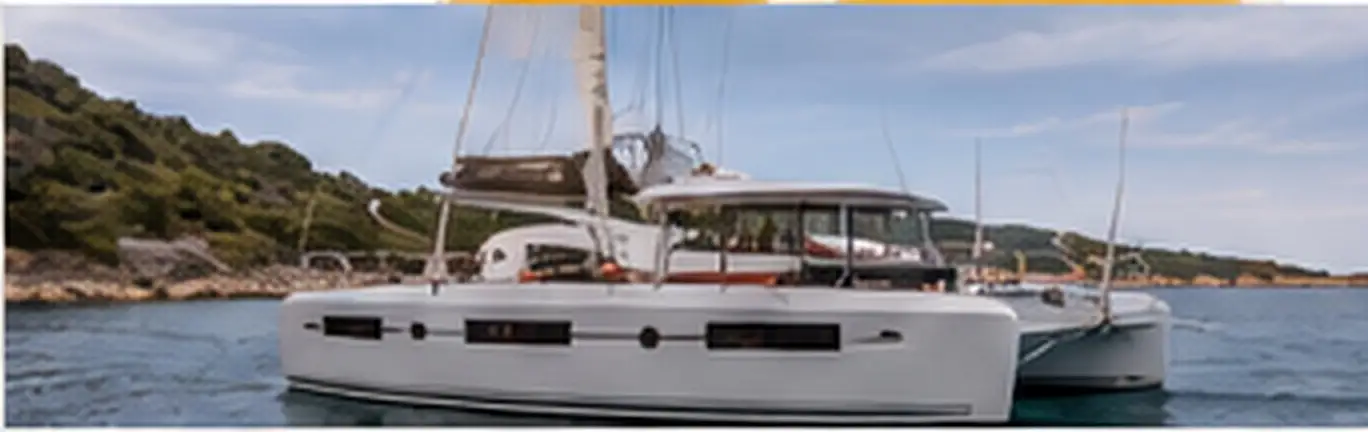
On the way back from Hvar, the fleet anchors in the bay of Lučice on Brač, one of those places that travellers going by land rarely discover, since the drive there is long and awkward. From the water it looks entirely different: stony slopes, pines running down to the shore, and a small beach that is far easier to reach by boat than by car. It is a good example of how the most interesting corners of the coast are rarely the ones next to the main roads.
The bays around Trogir and Čiovo
Towards the end of the week the route heads for Trogir, a UNESCO-listed town, and the neighbouring island of Čiovo. Here the landscape changes character: fewer wild cliffs, more stone architecture running straight down to the water, narrow channels between the island and the mainland. The bays around Čiovo are calmer and more sheltered, making them a good spot for the last anchorage before heading back to Split.
Trogir itself is worth an evening walk: the old town sits on a small island linked by bridges to the mainland and to Čiovo, and the Cathedral of St Lawrence, seen from the water, is one of those sights that stays with you. It is a good place for a quiet farewell to the Adriatic before the fleet sets off on the last leg to Split.
Why this matters for the whole fleet
With ten catamarans on the route, choosing a bay for the night is never left to chance. The skippers talk to each other, check the forecast for the hours ahead, and decide together which spot will give the best shelter and the calmest night for the whole fleet. That is why some bays on the route, like Nečujam or Lučice, come back into the programme again and again: they have proven themselves before, and they offer certainty rather than risk.
What makes a bay good for a fleet
- Shelter from the wind: a narrow entrance and hills around it that keep the water calm even when it is blowing harder out on the open sea.
- Enough depth to anchor safely a dozen or so metres from shore, with no risk to the keel.
- Access to the shore: a sandy or stony beach you can reach by tender or swim to.
- Quiet: no road in means no crowds, even at the height of the season.
- A view that changes through the day, from morning haze to golden light just before sunset.
- Water clear enough that you can see the bottom several metres down from the deck, which is invitation enough for a jump in.
The most common reaction to the first bay of the week is silence on deck. Not because there is nothing to say, just because nobody feels like saying it.
Each of these bays has its own moment in the Croatia 2026 week: Nečujam at the start, the Pakleni Islands in the middle, Lučice on the way back, the bays around Čiovo at the end. Together they form a route where the best views are not waiting in a guidebook, but around the next headland, reachable only one way.
It is also a good answer to the question of why it is worth sailing a catamaran at all instead of driving along the coast. The road shows you panoramas from above, from a distance. The water lets you in, into bays that are not visible from land at all, and that is a difference you feel once you are there, not in a photo.
Frequently asked questions
Yes, these are public Adriatic waters, but their appeal is that the easiest way in is from the sea, which a catamaran gives you without any extra planning.
Most bays on the route have a sandy or stony shore reachable from the water, though the main draw is always the swimming and the view, not the facilities on land.
That depends on the day and the weather, usually anywhere from an hour to a few hours, long enough to swim, go ashore, and simply rest before the next leg.