

Before someone sails a catamaran for the first time, they usually picture something between a film-set yacht and camping on water. The truth sits somewhere in between, closer to comfort than most people expect. This is a practical guide to what a day and night on board really look like, without polishing it up and without scaring anyone off.
We write it from the perspective of people who organise these weeks, not just join them, so we focus on the things that genuinely shape your comfort: where you sleep, how you eat, when you get privacy and when you are part of the group. The rest, the views and the islands, takes care of itself.
Cabins and shared space
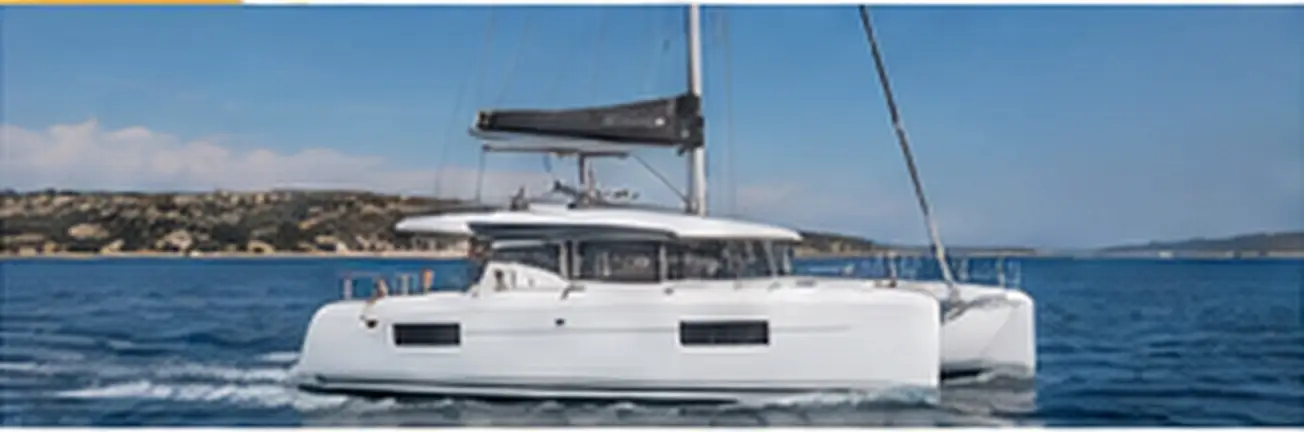
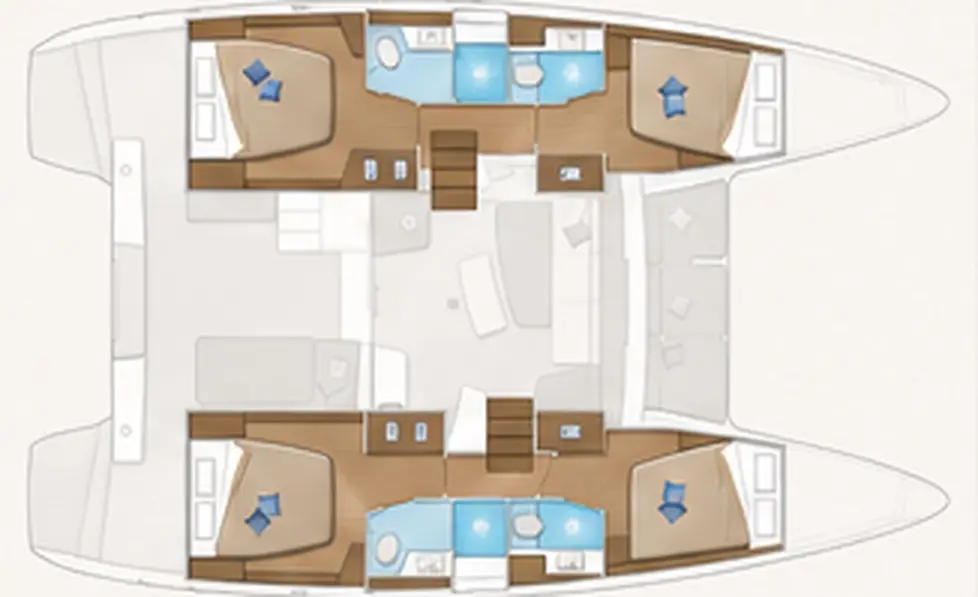
A catamaran has two hulls joined by a wide deck and a saloon in between, which gives more stability and space than a classic single-hull yacht. Cabins are private, with your own bed and room for luggage, and in the fleet's higher standards, Premium+ or Signature, your own bathroom too. The saloon and cockpit are the shared space where most of the day happens: meals, conversations, plans for the next stop.
It helps to drop the habit of thinking of the cabin as a hotel room where you spend most of the day. On a catamaran the cabin is mainly for sleeping and storing your things. The rest of the day happens on deck, in the water or ashore, so a smaller cabin does not mean a worse week.
It is also worth knowing that every catamaran has power on board, so charging a phone or a camera is never a problem, and larger ports and marinas usually have internet coverage too. At anchor in a smaller bay the signal tends to be weaker, which in practice turns out to be a plus rather than a problem.
What mornings look like
Mornings at anchor are usually the calmest part of the day. The water is flat before the wind picks up, the sun is just rising over the islands, and most of the crew wakes up without an alarm, because the light and the quiet do the job instead. Coffee on deck, sometimes a quick swim before breakfast, is the typical start of the day, before the catamaran sets off towards the next destination.
Water, food and the marina
Fresh water tanks on a catamaran have their limits, so a shower on board can be shorter than at home, and the marina is when supplies get topped up. Food depends on the day: sometimes it is a meal made on board from what was bought in port, sometimes dinner at a restaurant ashore, especially in bigger places like Hvar or Trogir. The marina is also a chance to step ashore, walk through a small town and feel a different rhythm than the one on the water.
The galley on board has a fridge, a stove and basic dishes, so breakfast or a light lunch is never a problem to put together. Real shopping happens in ports, where there are usually small grocery shops and markets with local produce: fruit, cheese, olive oil. It is a good moment to skip the restaurant and make dinner on board instead, watching the lights of the town across the bay.
A skipper who knows more than the chart
Every catamaran in the fleet has a professional skipper who knows the route, reads the weather and decides where it is safe to anchor for the night. They choose the moment to leave a bay before the wind picks up, and they know which anchorage will be calmer on any given day. That means guests on board can simply be on holiday, instead of worrying about navigation, weather or mooring manoeuvres.
The rhythm of a day, in short
If you had to sum up a week in one sentence, it would be this: calm in the morning, water and a move to the next place during the day, land or the deck in the evening, depending on the mood. There is no rigid schedule with boxes to tick. There is a frame for the day set by the sun and the route, and inside that frame everyone decides for themselves how much time to spend in the water, how much reading a book, and how much talking with the rest of the crew.
What to pack
- A soft bag instead of a hard suitcase: a catamaran has little room for rigid luggage, and a soft bag fits easily into a locker.
- Sandals or water shoes: rocks and jetties in ports can be rough, and getting into the water is easier in shoes.
- A light jumper for the evening: even in warmer climates it cools down after sunset, especially out on open water.
- Sunscreen and something to cover your head: most of the day is spent in the sun, often without shade for hours at a time.
- Fewer clothes than you think: a week on the water is mostly swimwear and something light for the evening, not a whole wardrobe.
- A waterproof phone pouch: it comes in handy far more often than you would think, especially when jumping straight off the deck.
What surprises first-timers the most
Most often it is how quickly the need for a phone disappears. By the second day most people stop checking notifications altogether, because there is no time or desire for it. It is also surprising how well you sleep at anchor, the rocking turns out to be soothing rather than annoying. And it is surprising how quickly strangers on the same deck start to feel like an old crew, because a week in that closeness works faster than a week in a hotel.
People come back surprised by one thing most often: how little they needed to feel good for a whole week.
If you want to test this rhythm on a smaller scale before committing to a full week on the Adriatic, Morning Escape on the Gulf of Gdańsk gives you a similar feel of a calm morning on the water in a few hours, without leaving the Tricity. It is a good way to feel what a day starting with coffee on deck is like, before you decide on a full week-long cruise on the Adriatic.
Frequently asked questions
Yes. Cabins lock and are private, and the shared space is large enough that it is easy to find a quiet moment on the bow, the stern or the deck when you need it.
Safety always comes first. The skipper decides the route and the anchorage based on the actual weather, and the day's plan adjusts to the conditions on the water.
No. The skipper runs the catamaran for the whole week, so guests do not need to know anything about sailing or take part in manoeuvres, unless they want to try.